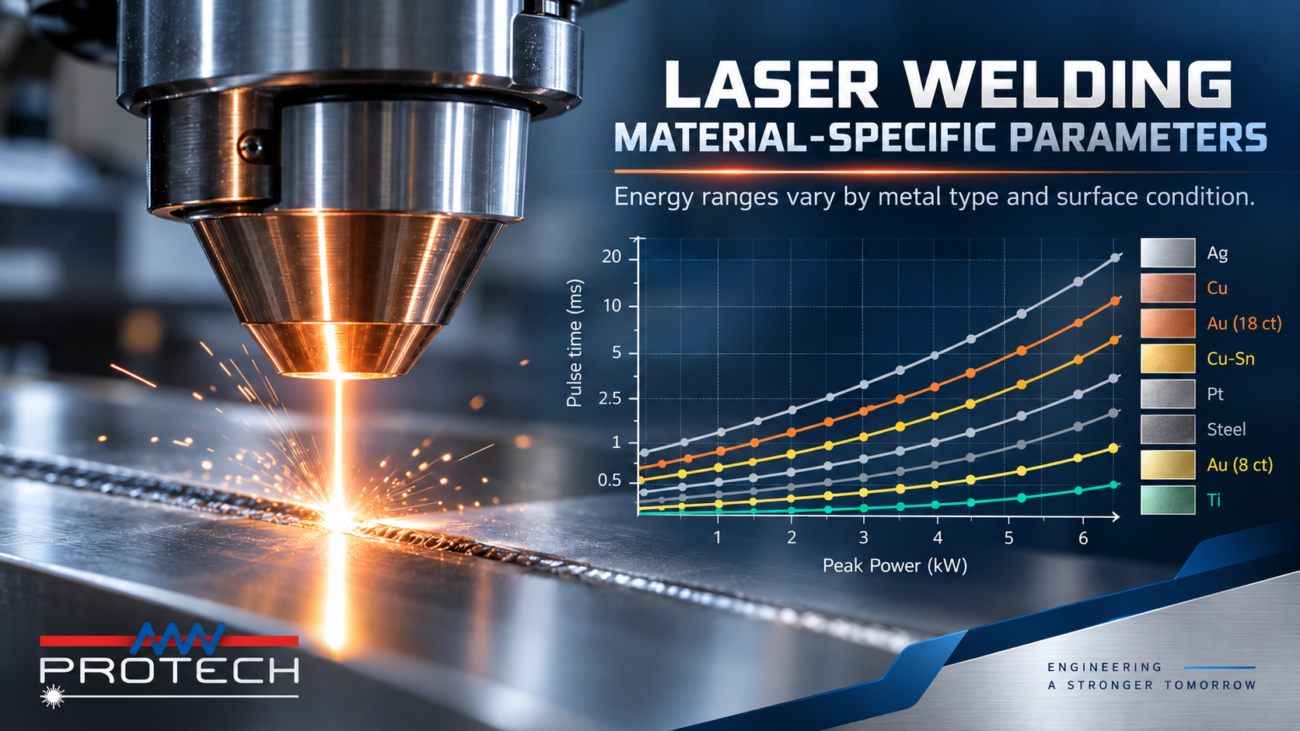
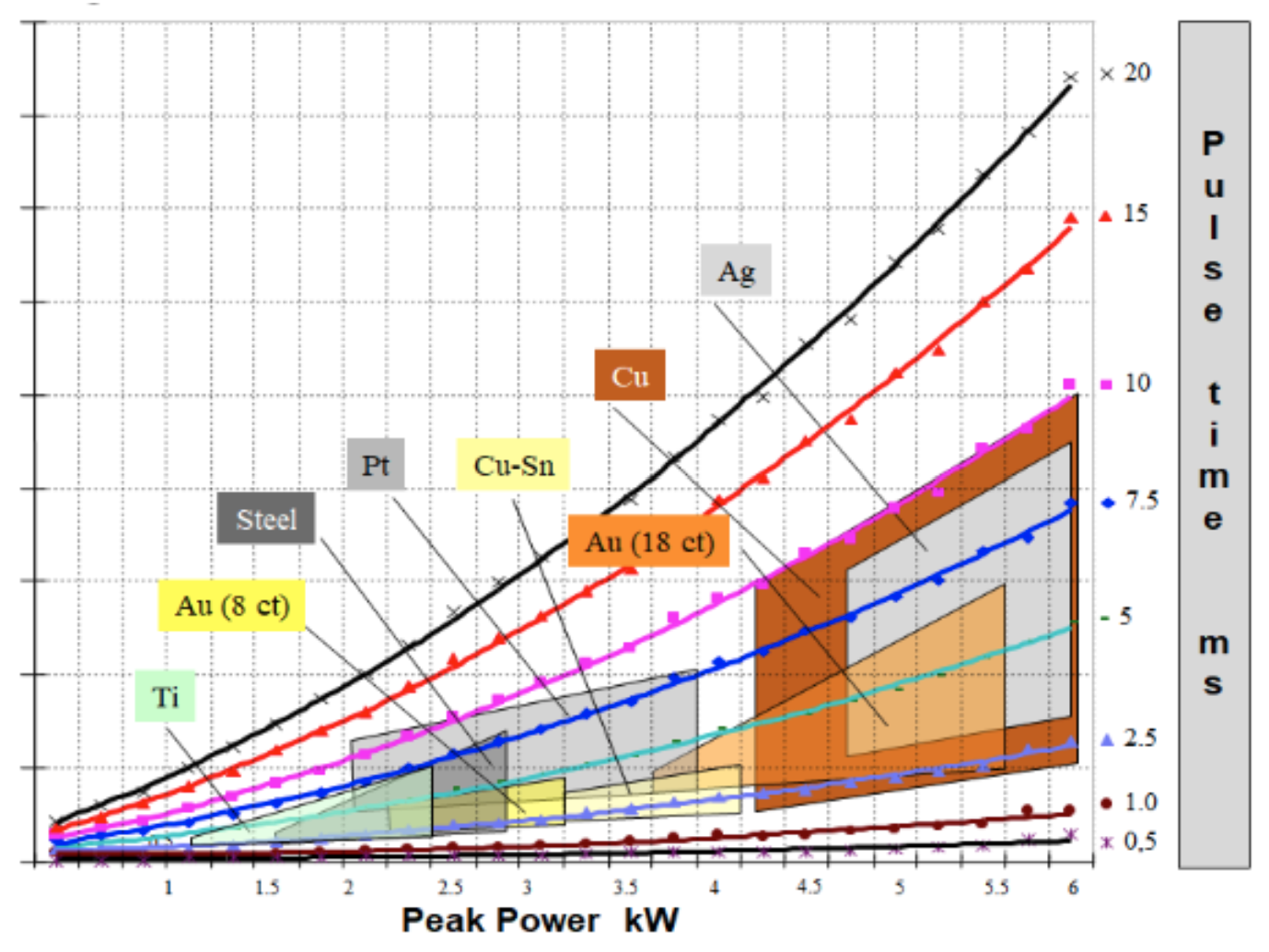
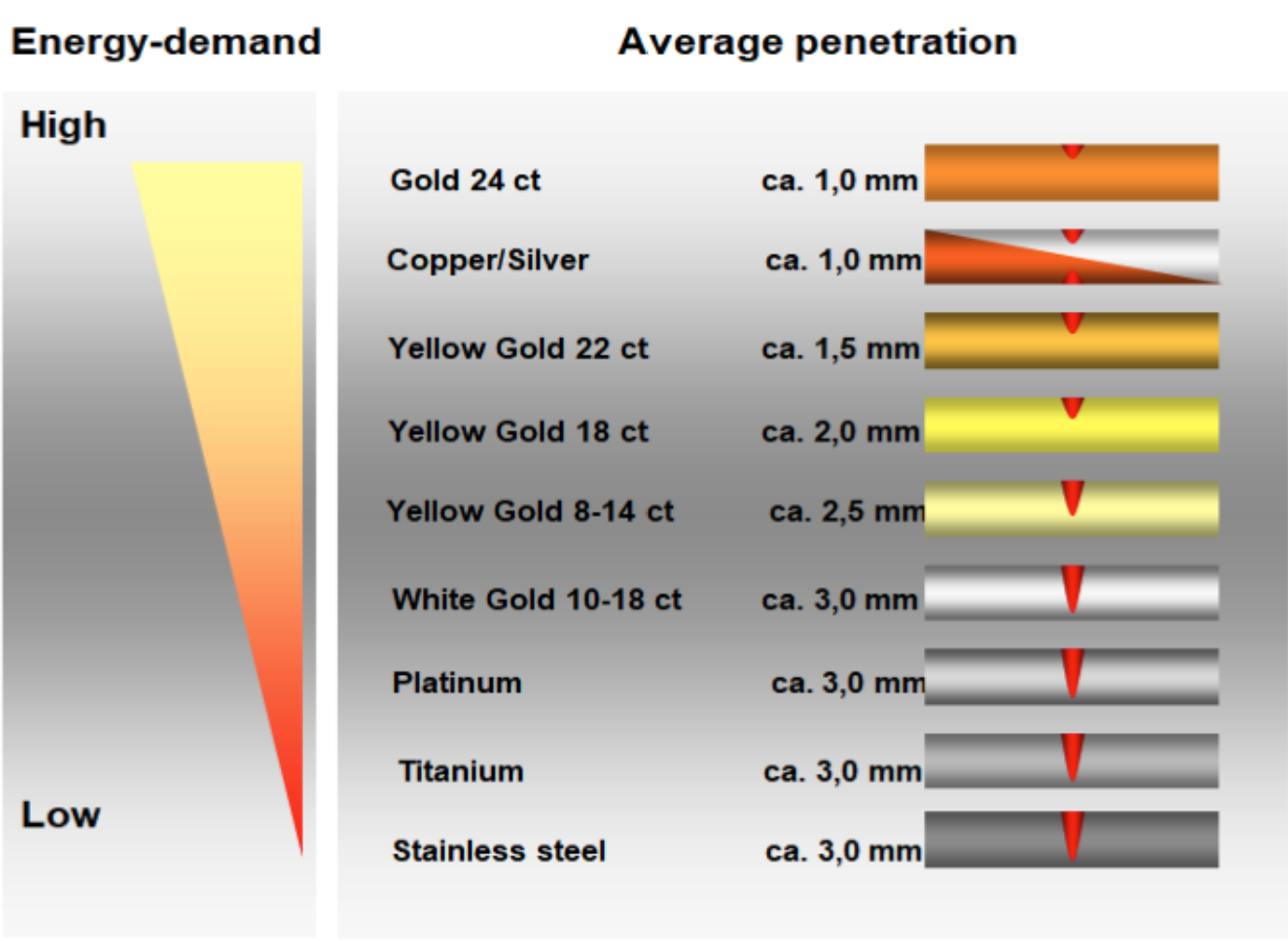
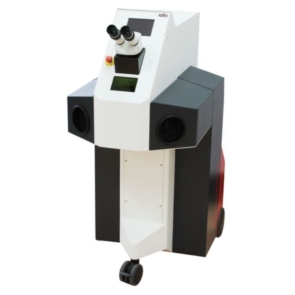
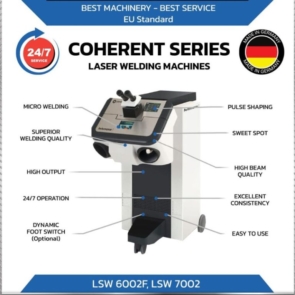
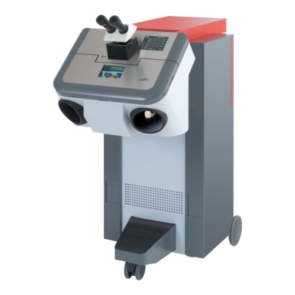
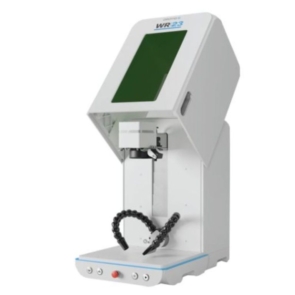
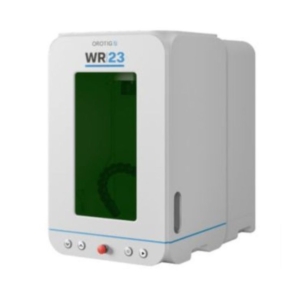
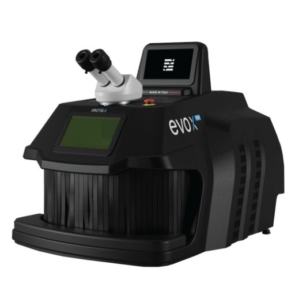
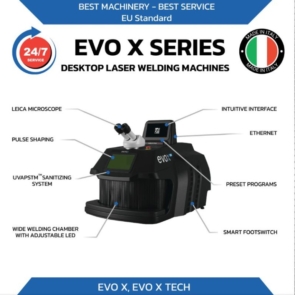
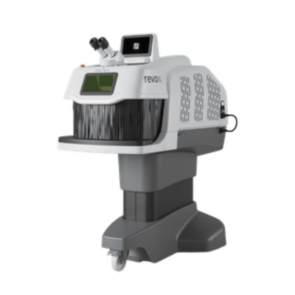
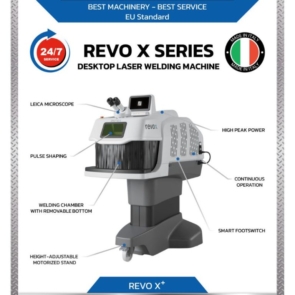
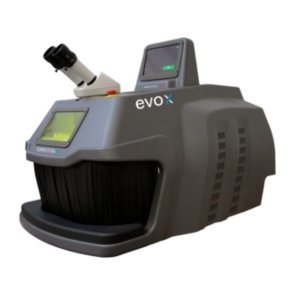
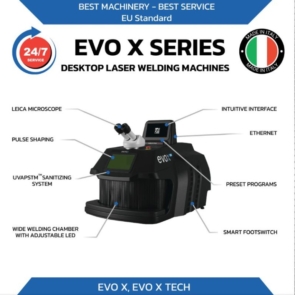
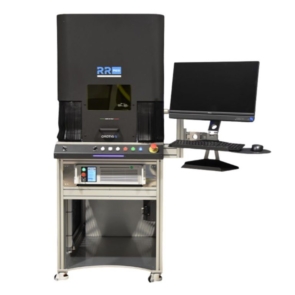
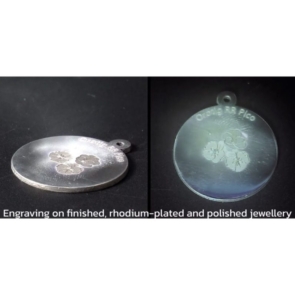
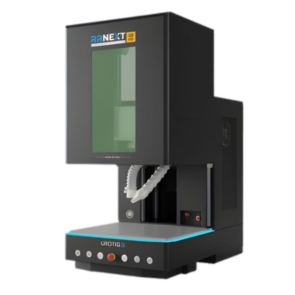
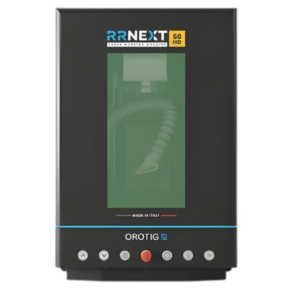
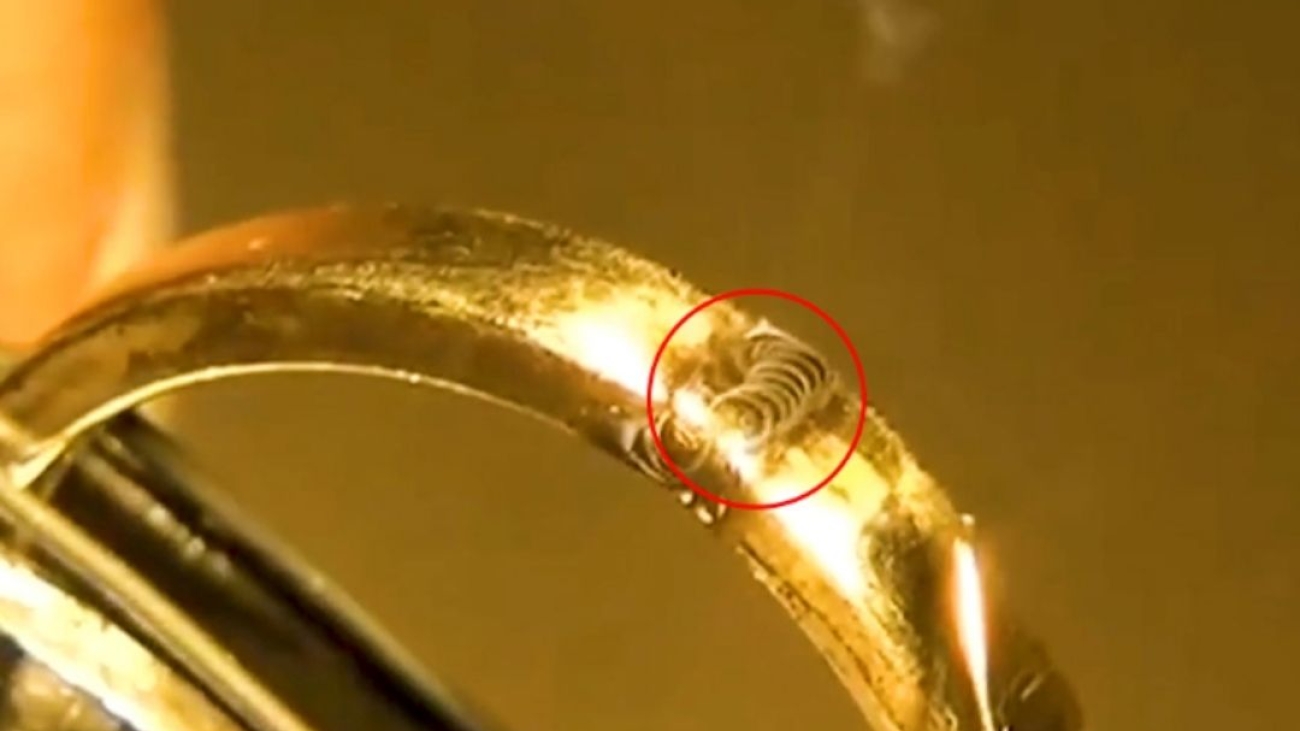
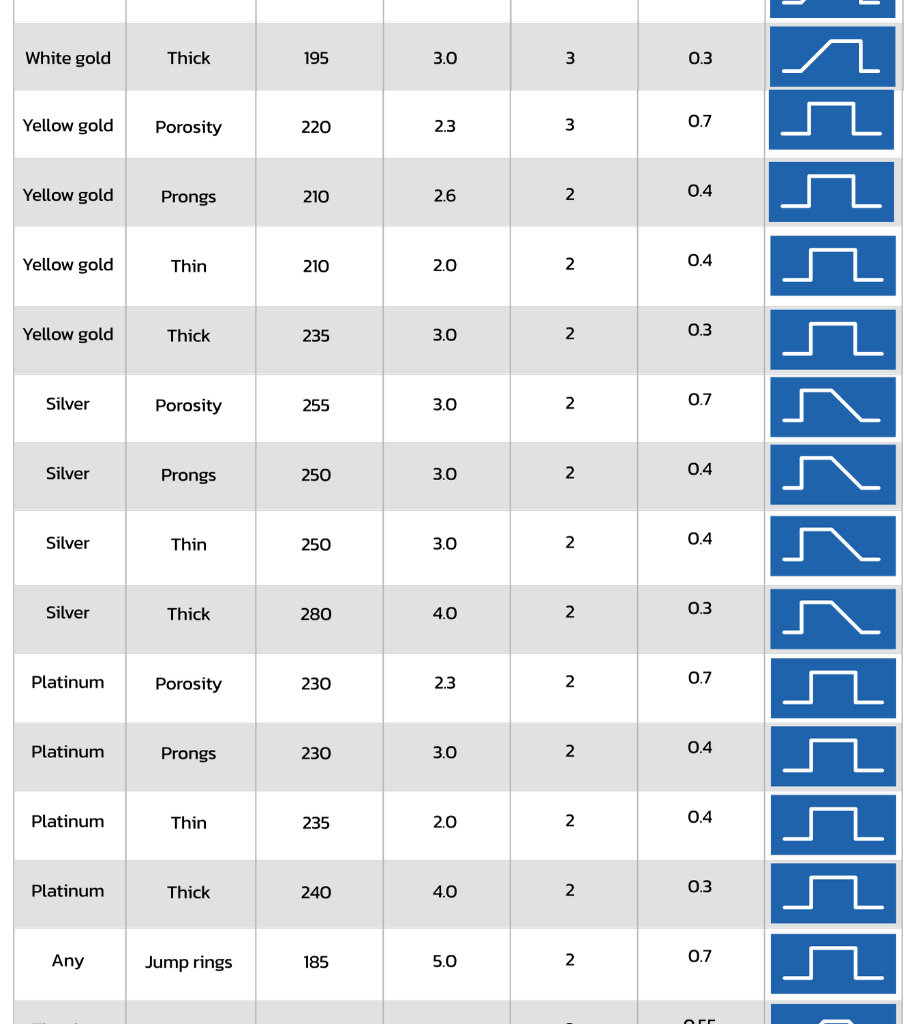
The absorption of laser energy depends on both the metal type and its surface condition (matte vs. polished). Use the table below as a starting point to determine the appropriate energy range. The operator should then manually adjust the power to optimize the welding results for the specific application.
Base Metals & Alloys:
Stainless Steel / Ti /CrCo / Pt: 230 – 270 V | 2.0 – 5.0 ms | 0.3 – 1.0 mm Focus
Steel: 282 V | 3.0 ms | 0.60 mm Focus | 3.0 Hz
Titanium: 390 V | 3.5 ms | 0.54 mm Focus | 2.0 Hz
Steel Micro: 320 V | 3.0 ms | 0.15 mm Focus | 3.0 Hz
Platinum (PT): 300 V | 2.0 – 2.5 ms | 0 – 10 mm Focus | 0 – 10 Hz
Platinum (Image 1): 305 V | 3.5 ms | 0.40 mm Focus | 3.0 Hz
Copper: 282 V | 3.5 ms | 0.33 mm Focus | 4.0 Hz
Aluminum: 282 V | 5.0 ms | 0.50 mm Focus | 3.0 Hz
Silver Alloys:
Silver: 300 – 370 V | 4.0 – 8.0 ms | 0.3 – 0.4 mm Focus
Silver (Image 1): 190 V | 3.5 ms | 0.50 mm Focus | 4.0 Hz
Silver 92.5: 220 V | 2.0 – 2.3 ms | 0 – 10 mm Focus | 0 – 10 Hz
White Gold (WG) / White Metals:
White Brass: 300 V | 1.3 ms | 1.22 mm Focus | 70 Hz | 99 Pulse
White Gold 10k (10 K WG): 210 V | 1.1 – 1.3 ms | 0 – 10 mm Focus | 0 – 10 Hz
White Gold 14k (14K WG): 240 V | 1.4 – 1.6 ms | 0 – 10 mm Focus | 0 – 10 Hz
White Gold 18k (18K WG): 240 – 280 V | 2.0 – 4.0 ms | 0.4 – 0.8 mm Focus
White Gold 18k (18K WG – alternate): 270 – 300 V | 2.0 – 5.0 ms | 0.3 – 0.5 mm Focus
White Gold 18k (18K WG – Image 1): 210 V | 1.5 – 1.6 ms | 0 – 10 mm Focus | 0 – 10 Hz
White Gold 14k (Image 1): 252 V | 3.0 ms | 0.40 mm Focus | 3.0 Hz
Yellow Gold (YG) Alloys:
Yellow Gold 10k (10K YG): 250 V | 1.3 – 1.5 ms | 0 – 10 mm Focus | 0 – 10 Hz
Yellow Gold 14k (14K YG): 270 V | 1.5 – 1.6 ms | 0 – 10 mm Focus | 0 – 10 Hz
Yellow Gold 18k (18 K YG): 300 V | 1.7 – 1.8 ms | 0 – 10 mm Focus | 0 – 10 Hz
Yellow Gold 14k (Image 1): 292 V | 3.2 ms | 0.40 mm Focus | 3.0 Hz
Gold w/14k (Image 1): 389 V | 3.5 ms | 0.40 mm Focus | 3.0 Hz
Featuring Indutherm VC200 and VC700V with Complete Manufacturing Solutions Designed to Enhance Efficiency, Precision and Production Performance
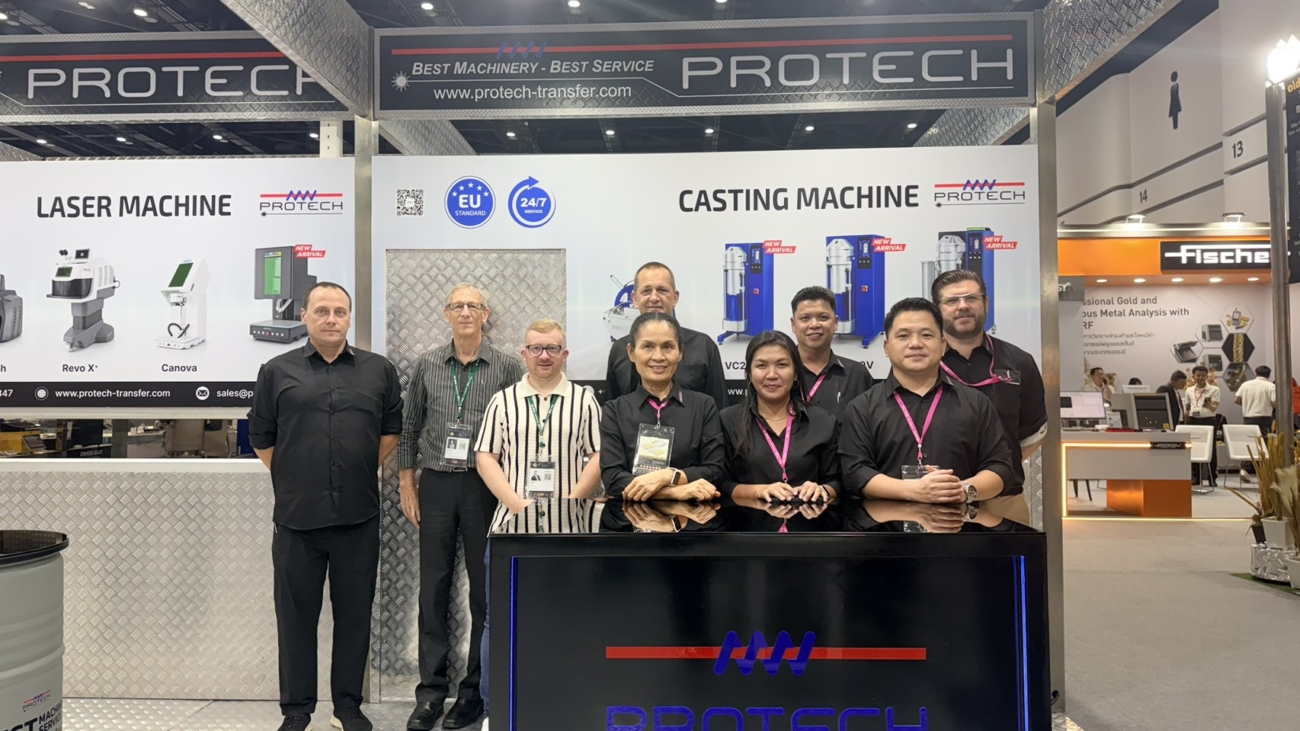
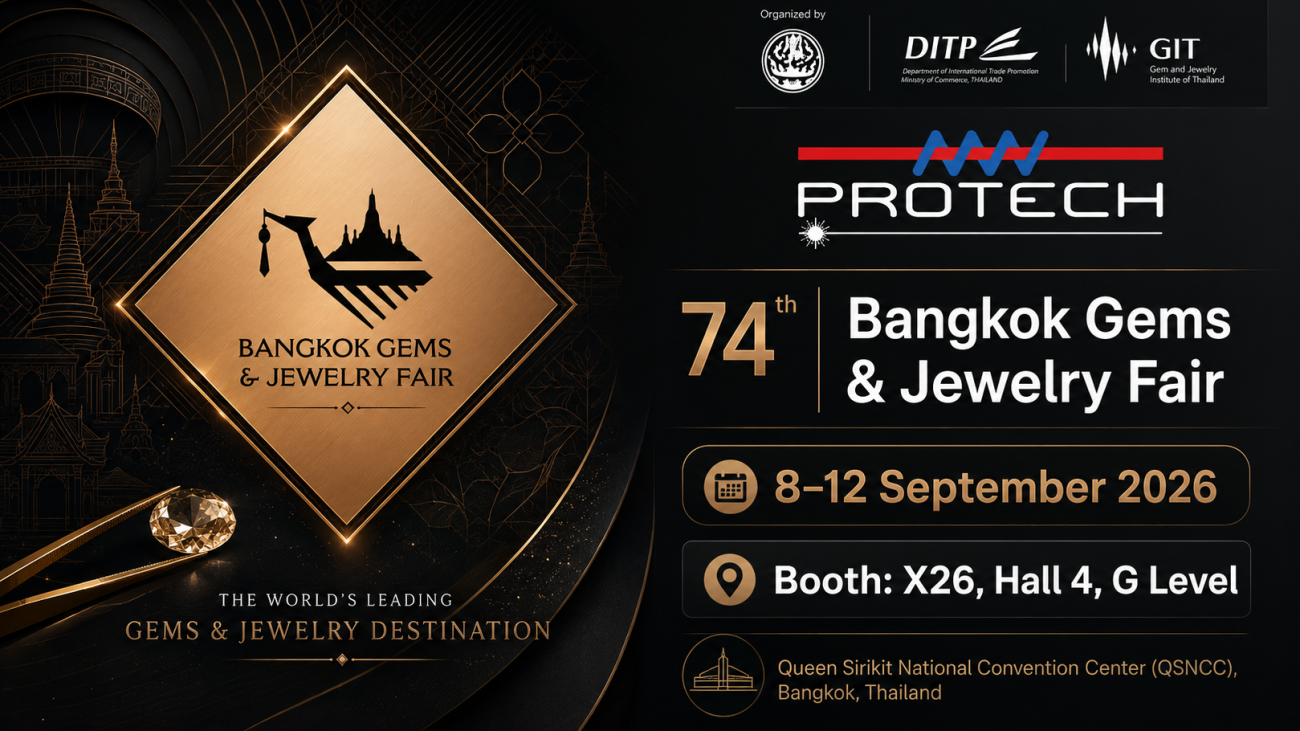
Bangkok, Thailand – Protech Transfer, a leading provider of machinery and technology solutions for the jewelry manufacturing industry, will showcase advanced manufacturing technologies and world-class machinery at the 74th Bangkok Gems & Jewelry Fair (BGJF74), taking place from 8–12 September 2026 at the Queen Sirikit National Convention Center (QSNCC), Bangkok.
Under the concept of advancing modern jewelry manufacturing. Protech Transfer will present technologies designed to help manufacturers achieve greater precision, efficiency, process stability, automation and quality consistency.
Advancing Jewelry Manufacturing Through Technology
As the jewelry industry continues to face increasing demands for quality, production flexibility, cost efficiency and shorter lead times, manufacturers are looking for technologies that can deliver more than simply higher production capacity.
At BGJF74, Protech Transfer will present a comprehensive portfolio of manufacturing solutions covering key production processes, including automated vacuum pressure casting, granulation, surface finishing, laser welding, laser marking, polishing and advanced electro finishing technologies.
The solutions are powered by leading international brands, including Indutherm, OTEC and Orotig and are designed to support manufacturers looking to improve production efficiency, reduce processing time, minimize rework and achieve more consistent results.
The technologies can support a wide range of materials, including gold, silver, platinum, palladium, stainless steel, CoCr, brass and other industrial materials, providing manufacturers with greater flexibility to meet different production requirements.
Indutherm New Models VC200 and VC700V
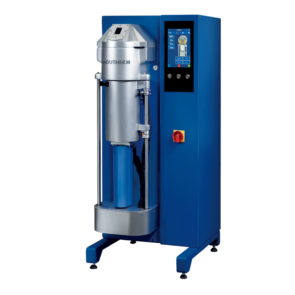
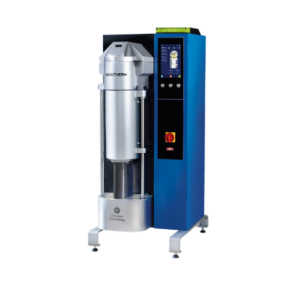
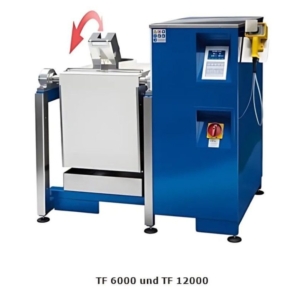
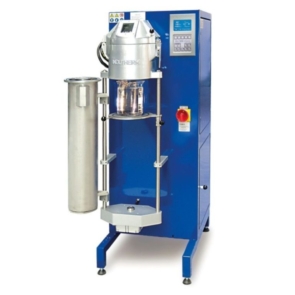
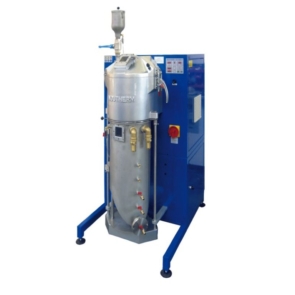
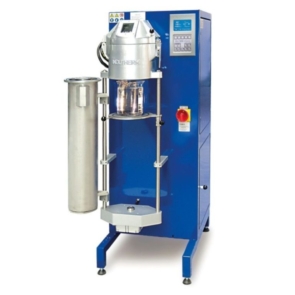
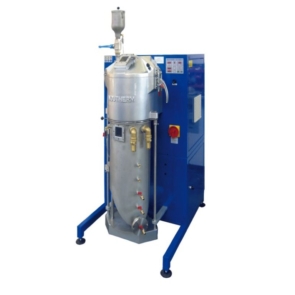
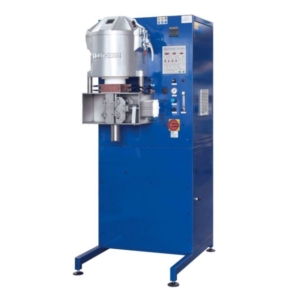
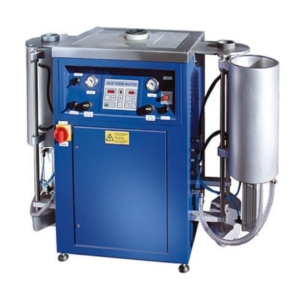
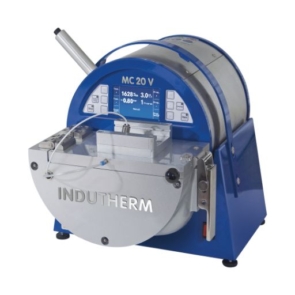
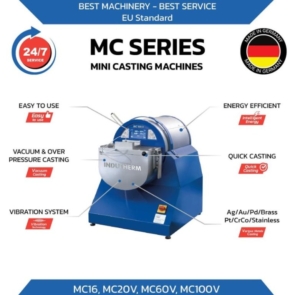
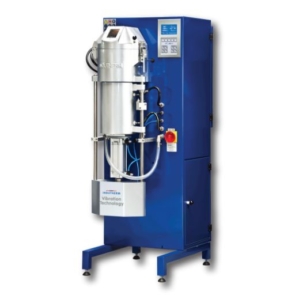
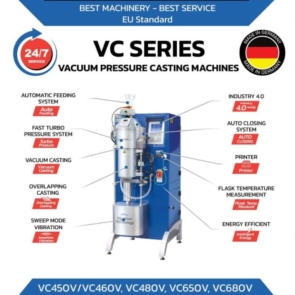
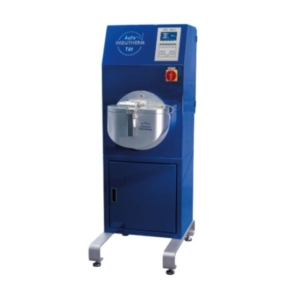
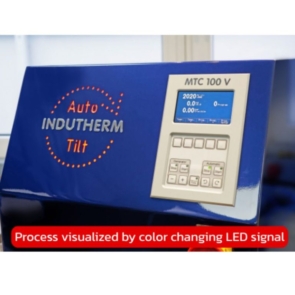
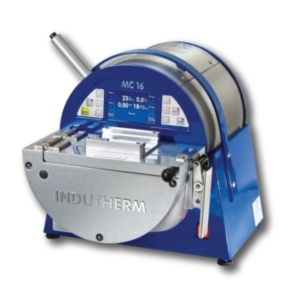
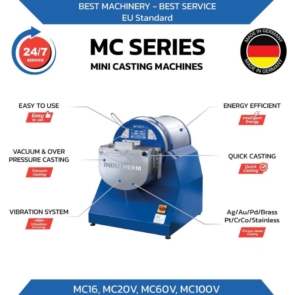
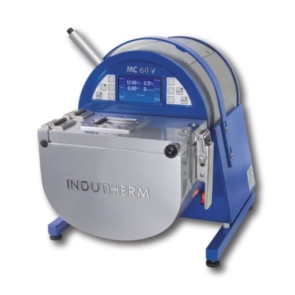
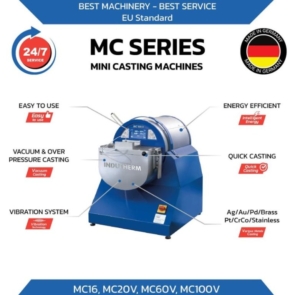
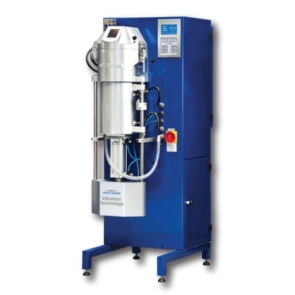
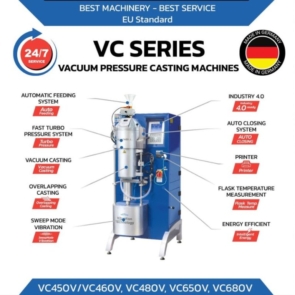
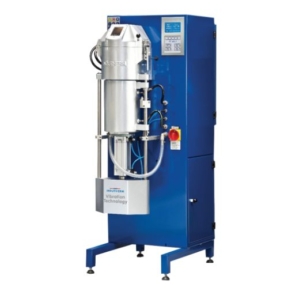
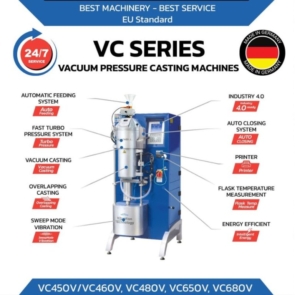
A key highlight of Protech Transfer’s exhibition this year will be the Indutherm VC200 and VC700V, showcasing advanced new models of vacuum fast pressure casting technology designed for modern efficient jewelry manufacturers.
Indutherm VC200 – Flexible Casting for Modern Production
The Indutherm VC200 is designed for manufacturers seeking a reliable and flexible casting solution for a wide range of production requirements.
With advanced process control and a focus on stable casting performance, the vacuum fast pressure VC200 helps manufacturers improve production efficiency while reducing limitations associated with conventional casting processes.
Indutherm VC700V – Advanced Automation for Consistent Casting
The Indutherm VC700V represents another important step toward more automated and controlled vacuum fast pressure casting processes.
By combining automation with advanced process control, the system is designed to improve precision, consistency, and repeatability, helping manufacturers reduce process variations and achieve greater confidence in the quality of finished components.
For manufacturers looking to increase production performance and prepare their operations for more advanced manufacturing environments, the VC700V offers a technology driven approach to modern casting.
More Than Machinery – Complete Manufacturing Solutions
For Protech Transfer, technology is not simply about supplying machines. It is about understanding each customer’s production process and finding the right solution for their specific requirements.
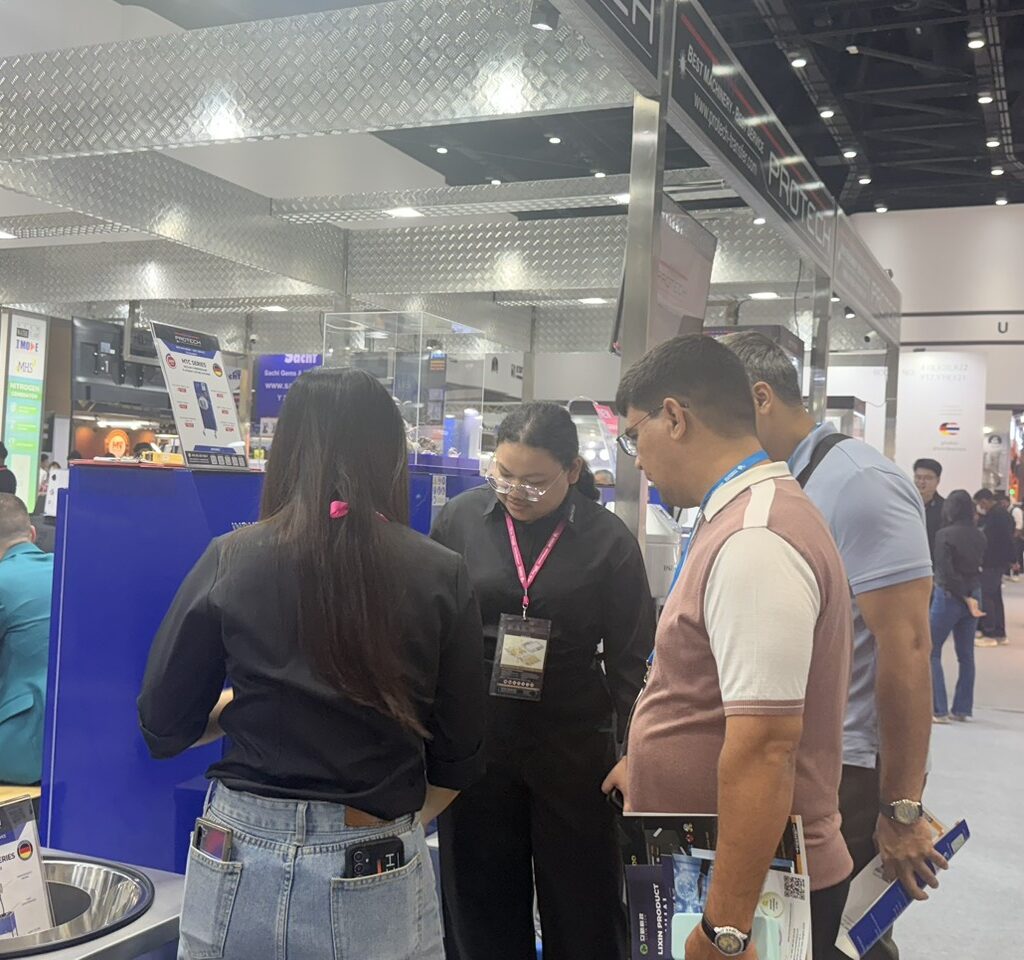
At BGJF74, visitors will have the opportunity to discuss their production challenges directly with Protech Transfer’s technical team, including machine selection, process improvement, application requirements and production optimization.
Protech Transfer also provides comprehensive after-sales support, including Technical Training, Service, Maintenance and Engineering Support, helping customers maximize machine performance and maintain long-term production efficiency.
Building Stronger Manufacturing Capabilities Together
Ralf Oberg, Managing Director of Protech Transfer, said:
“The jewelry manufacturing industry is continuously evolving. Manufacturers today are not simply looking for machines that can perform a task. They are looking for automated technologies that can deliver greater precision, consistency, efficiency and flexibility while responding quickly to changing market requirements.
Bringing the Indutherm VC200 and VC700V to BGJF74 represents another step in introducing advanced casting technology to the jewelry manufacturing industry in Thailand. These new machines can be externally controlled and casting machine operators need less expertise. Jewelry manufacturers gain greater control over the their production.
At Protech Transfer, our focus goes beyond supplying machinery. We take the time to understand our customers’ production processes and identify technologies that can address their real challenges. Our goal is to be a long-term technology partner, helping manufacturers in Thailand strengthen their capabilities and compete confidently in the global market.”
Meet Protech Transfer at BGJF74
Protech Transfer invites jewelry manufacturers, OEM/ODM factories, designers and industry professionals to visit our booth at the 74th Bangkok Gems & Jewelry Fair and explore the latest manufacturing technologies from Indutherm, OTEC, Orotig and Other Brands.
Visitors can discover advanced machinery and complete solutions for jewelry manufacturing, while discussing their production challenges and opportunities for improving efficiency with Protech Transfer’s technical specialists.
Event Information
74th Bangkok Gems & Jewelry Fair (BGJF74) Date: 8–12 September 2026 Venue:Hall 4, Level G | Booth X26 Queen Sirikit National Convention Center (QSNCC), Bangkok Exhibitor: Protech Transfer – Machinery & Technology Solutions
Discover VC200 and VC700V, along with advanced machinery and technologies designed to support the complete jewelry manufacturing process.
Protech Transfer – Technology for Better Manufacturing.
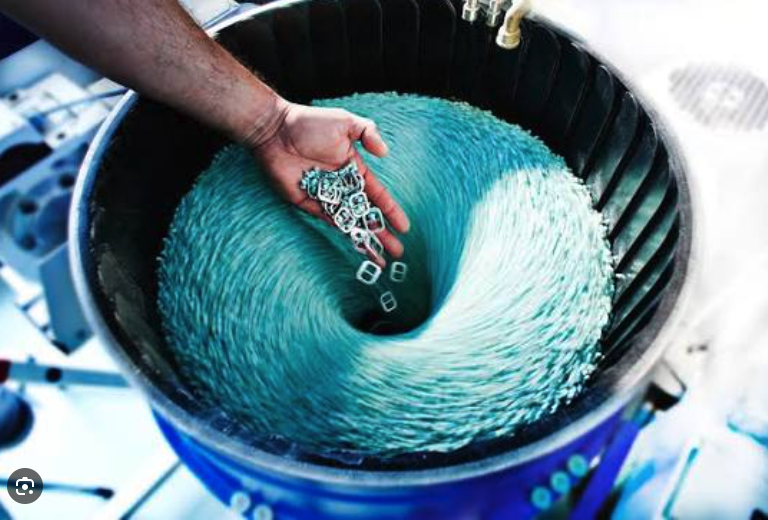
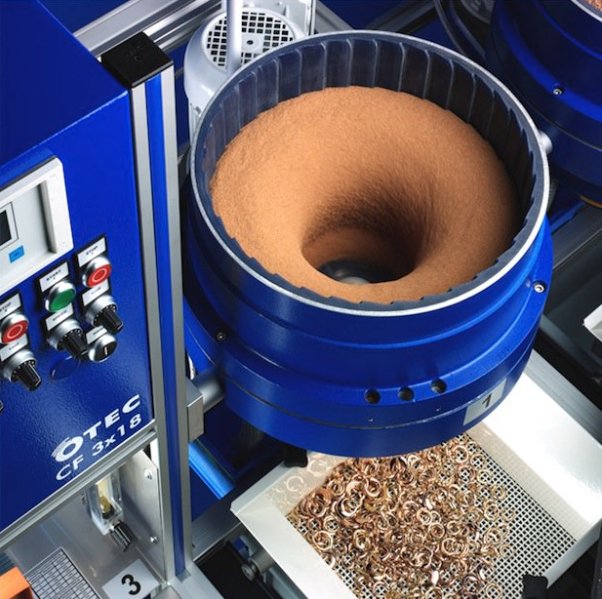
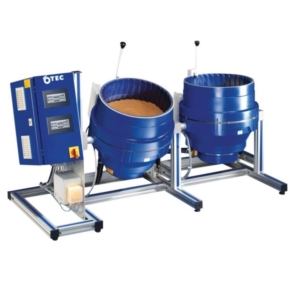
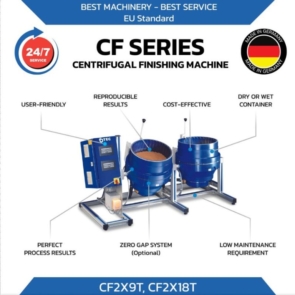
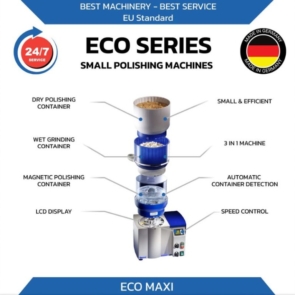
CF (Centrifugal Force) Grinding and Polishing is a process used to smoothen and improve the surface quality of metal parts by using centrifugal forces. It is widely used in industries such as jewelry, automotive, aerospace, and medical devices, where precision and surface quality are critical. The process can be applied to a variety of metals like Brass, Silver, Gold, Stainless Steel, Titanium, etc.
Benefits of CF Grinding and Polishing
Grinding
This is the initial step to remove significant surface imperfections, such as scratches, burrs, or uneven areas on the metal surface. Abrasive tools or wheels are used to grind the metal, leaving it relatively smooth but not completely polished.
Polishing
After grinding, the surface is further smoothed by polishing to eliminate any fine scratches or irregularities. Polishing improves the surface appearance but still may leave micro-level imperfections.
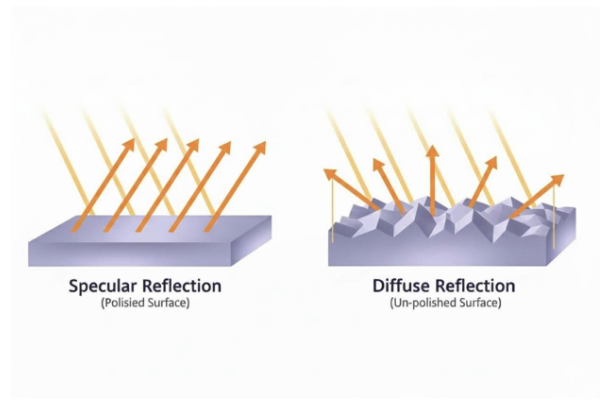
No smooth surface, no true shine
Types of CF Grinding and Polishing
There are two main types of CF processes based on the type of finishing required:
CF Grinding (Surface Smoothing)
This process focuses on removing material to smooth the surface of the metal. It’s typically used in the early stages to remove sharp edges, burrs, or rough surfaces.
Media Used: Abrasive media such as ceramic, plastic, or steel shapes.
Applications: Removing scratches, deburring, and preparing the surface for further polishing.
CF Polishing (High Gloss Finishing)
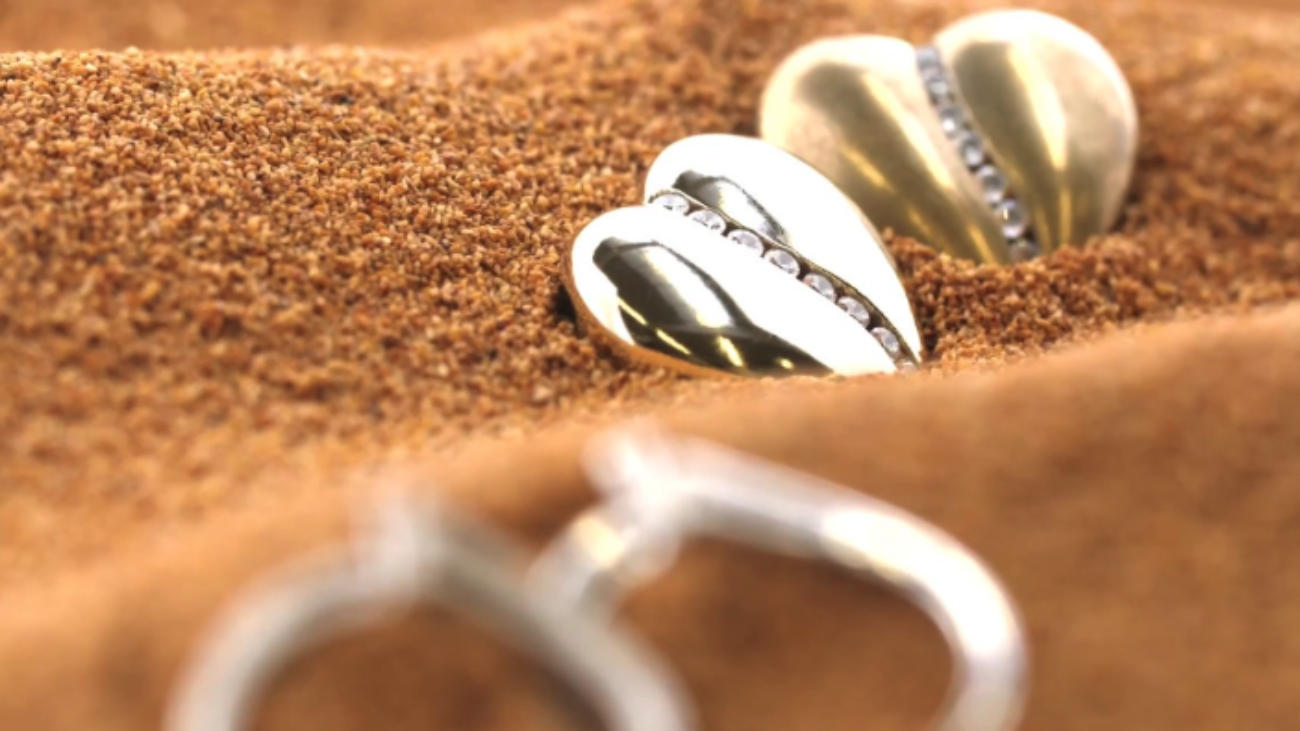
CF polishing is the next step after grinding, where the goal is to create a high-shine, mirror-like surface.
Media Used: Polishing compounds and media made of softer materials like walnut shells or rubber-based compounds.
Applications: Final finish for decorative parts, jewelry, and components requiring high precision and aesthetic quality.
Conclusion
CF Grinding and Polishing is an efficient and versatile method for improving the surface quality of metal parts. By carefully selecting the correct media, compounds, machine settings, and processing time, users can achieve a range of finishes from smooth to high-gloss polish, suitable for various industrial applications.
By the Application Engineering Team at ProTech Transfer Co., Ltd.
Most jewelry workshops are built around Gold and Silver. The Casting machines, the habits, the intuition, all of it is tuned to precious metals that flow freely and forgive small mistakes. Then a client asks for stainless steel and suddenly the rules change completely.
Stainless steel investment casting is one of the fastest-growing areas in the jewelry industry. Watches, clasps, rings, pendants, surgical-grade jewelry and high-wear fashion pieces are driving demand. But many workshops that try to make the jump end up with the same frustrating results: rough surfaces, incomplete fills and high reject rates. The good news is that these problems are not bad luck. They are predictable and they are fixable.
The Metal Is Not the Problem. The Process Is.
Gold melts at around 1,064°C and flows easily into a mold, while stainless steel casting requires temperatures near 1,500°C and exhibits very different metal flow behavior, moving more like a viscous fluid. This fundamental difference impacts the entire casting process, starting with a critical but often underestimated factor: wax tree design.
A sprue design and feeder system that performs well for gold and silver will fail in stainless steel casting. The metal is heavier, flows slower and solidifies faster in narrow channels. To ensure proper mold filling, sprues must be significantly larger — typically 1.2 to 1.5 times the thickness of the thickest section. Undersized sprues lead to premature solidification and incomplete casting defects, which cannot be corrected by adjusting temperature control alone.
Similarly, properly sized feeders are essential. As stainless steel undergoes approximately 4% solidification shrinkage, insufficient feeders result in internal porosity in casting, often undetectable until finishing — at which point the piece becomes scrap. Optimized feeder placement ensures continuous metal supply, improving casting quality and reducing reject rates.
Investment Selection: The Step Most Workshops Get Wrong
If your workshop currently uses gypsum-bonded investment, the standard plaster for gold and silver, you cannot use it for stainless.
Gypsum breaks down between 700–800°C, releasing sulphur gases directly into your mold. Those gases dissolve into the molten stainless steel and appear as gas porosity, small bubbles trapped inside the casting that weaken the piece and ruin the surface. The correct choice is phosphate-bonded investment. It remains stable well above 1,000°C, expands predictably so the mold does not crack and allows gases to escape rather than trap. Switching investment material alone eliminates one of the most common casting defects workshops experience when moving to stainless.
Temperature Control: Narrow Windows, Big Consequences
Stainless steel has a very specific pouring window: between 1,500°C and 1,550°C. Below that, the metal begins to freeze before it fills the mold, this is called a misrun and it means an incomplete casting. Above that range, surface quality degrades rapidly.
Your flask also needs to be at the right temperature when you pour — typically 850–950°C depending on section thickness. A mold that has cooled too much will cause the metal to freeze in the channels before reaching thin sections. This is one of the leading causes of incomplete mold filling in jewelry casting and it is almost always a temperature management issue rather than a machine issue.
Pouring Method Matters More Than You Think
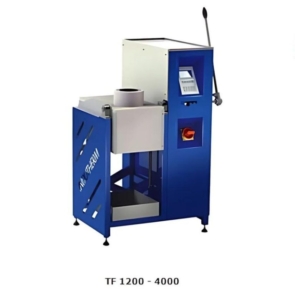
Modern casting machines designed for difficult alloys like stainless, platinum or palladium, use a tilting pour system rather than a traditional bottom-drain crucible. When the crucible tilts, the metal is transferred horizontally rather than dropped from above. This smooth, wave-like motion keeps impurities at the surface rather than folding them into the casting and combined with vacuum-assisted filling, it pushes metal into fine details that low-fluidity alloys would otherwise leave unfilled.
The result is a dramatic reduction in casting rejects (reduce casting reject), cost reduction in casting and a surface finish consistent enough to go directly to polishing without remedial work.
The Takeaway
Stainless steel casting rewards process discipline and process optimization. By upsizing your sprue design and feeder system beyond what gold and silver require, switching to phosphate-bonded investment and maintaining precise temperature control, your casting defects and reject rate will decrease significantly.
The learning curve is real, but with a clear understanding of metal flow behavior, solidification shrinkage and the root causes of porosity in casting, improvement comes quickly.
For workshops aiming to expand into stainless steel casting, platinum casting or other high-temperature alloy casting, ProTech Transfer Co., Ltd. provides technical consultation and industrial casting solutions in Thailand. www.protech-transfer.comThe Takeaway
Protech Transfer is pleased to announce our participation in the 74th Bangkok Gems & Jewelry Fair 2026, one of the world’s leading gems and jewelry trade fairs. The event will take place from 8–12 September 2026 at the Queen Sirikit National Convention Center (QSNCC), Bangkok, Thailand.
As a trusted partner for jewelry manufacturing machinery and after-sales service in Thailand, Protech Transfer will be showcasing solutions designed to support modern jewelry production, including machinery for casting, laser, polishing, finishing and related manufacturing processes.
Visit Protech Transfer at Booth X26, Hall 4, G Level
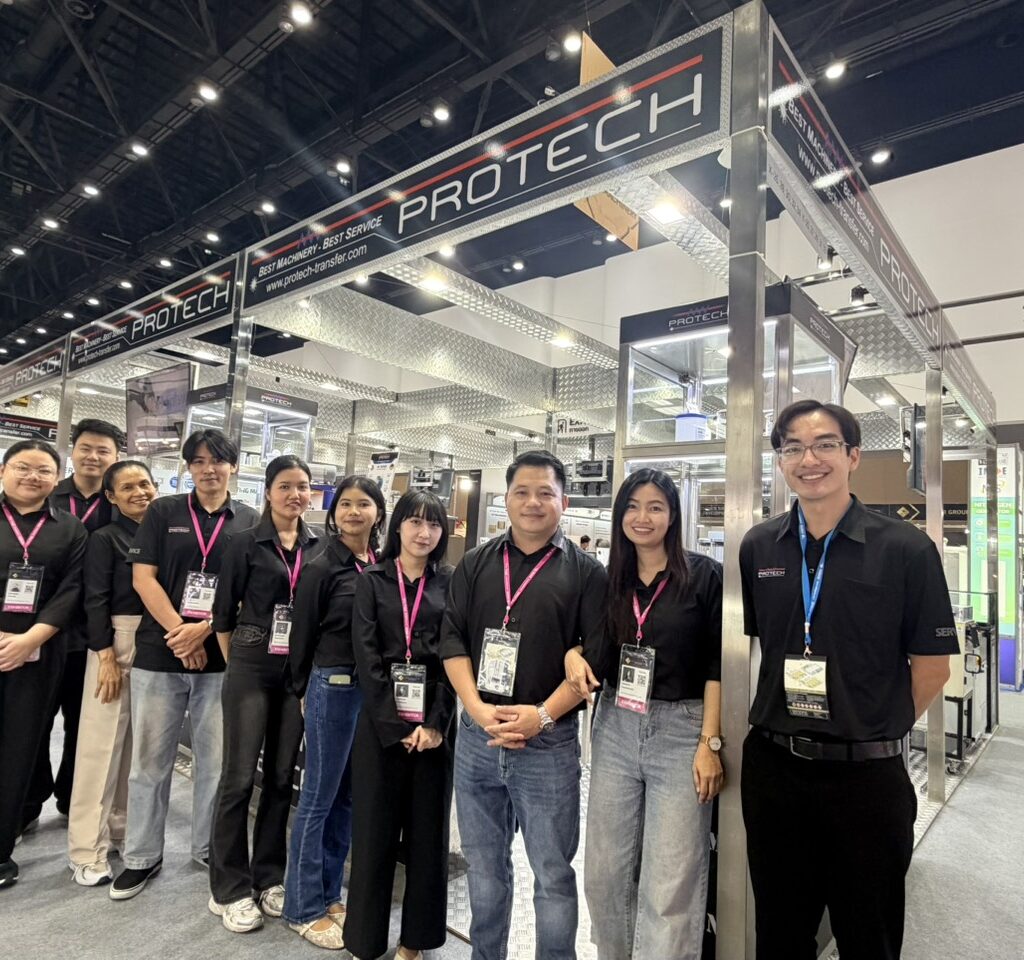
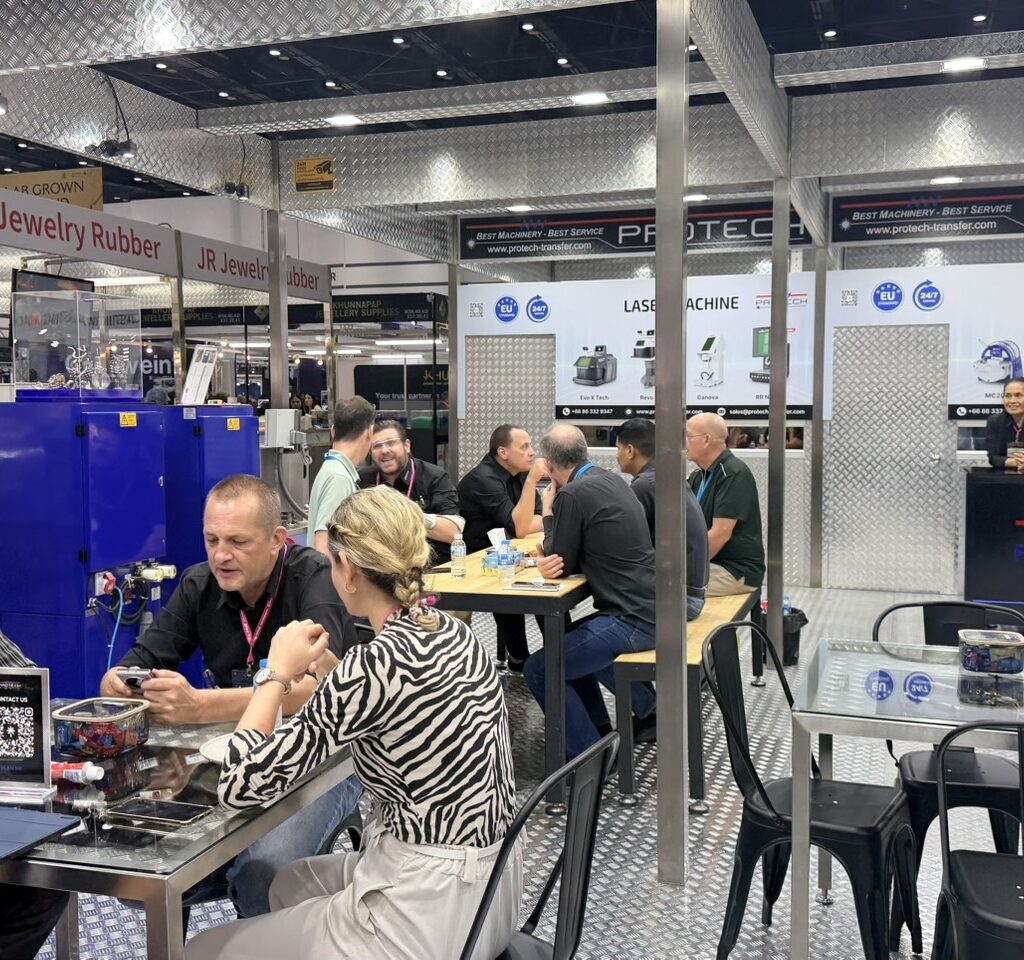
At our booth, visitors will have the opportunity to meet the Protech Transfer team and explore how our machinery and technical support can help improve production efficiency, consistency and overall product quality.
Whether you are looking to upgrade your production line, improve finishing quality or consult with specialists about the right machinery for your business, our team will be available throughout the event to provide professional recommendations and support.
Why Visit Our Booth?
At Protech Transfer, we understand that jewelry manufacturing requires precision, reliability and long-term technical support. Our solutions are developed to help manufacturers achieve better production results with greater confidence.
Visitors can learn more about:
Jewelry manufacturing machinery and production solutions
Casting, laser, polishing and finishing processes
Machine selection for different production needs
After-sales service and technical support
Long-term maintenance and service solutions
Event Details
Event: 74th Bangkok Gems & Jewelry Fair 2026 Date: 8–12 September 2026 Venue: Queen Sirikit National Convention Center (QSNCC), Bangkok, Thailand Booth: X26, Hall 4, G Level
Protech Transfer looks forward to welcoming customers, partners and jewelry manufacturing professionals to our booth. Come meet our team and discover how we can support your production with reliable machinery, expert knowledge, and professional service.
We look forward to seeing you at Booth X26, Hall 4, G Level.
Every jewelry workshop knows the bottleneck. A batch of casted pieces sits waiting while one or two skilled polishers work through them by hand wheel by wheel, ring by ring. It is slow, inconsistent and expensive. Trained polishers are hard to find and their output varies from person to person, day to day. For many workshops, the polishing bench is the single biggest constraint on how much they can produce.
There is now a better way, and it is called Electro Finishing.
What Electro Finishing Actually Is
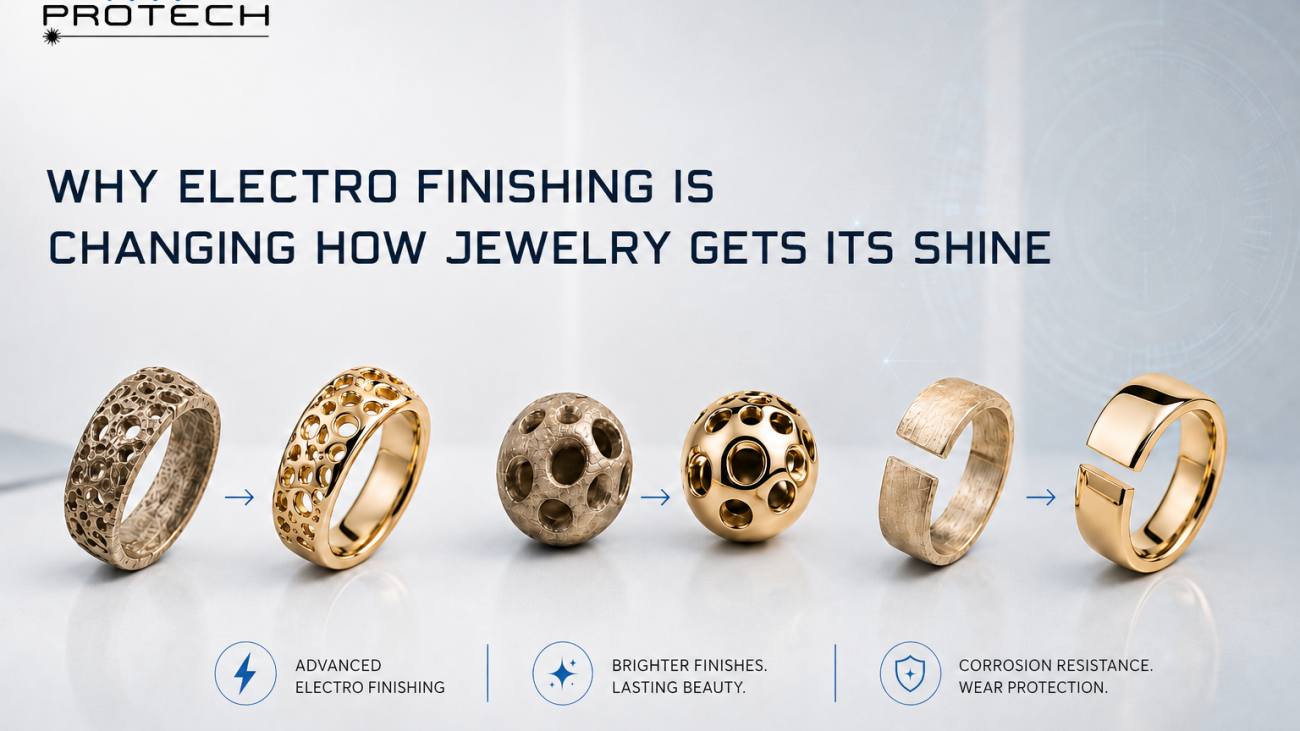
Electro Finishing, often called electropolishing, is an electrochemical process. The piece of jewelry is submerged in a special electrolyte liquid and connected to an electrical current. The current causes microscopic peaks and roughness on the metal surface to dissolve away selectively, leaving behind a smooth surface, uniformly bright surface.
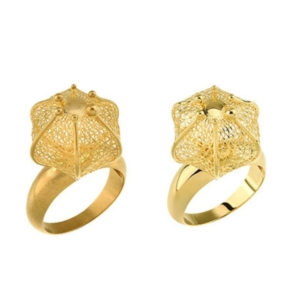
Unlike grinding or abrasive polishing, nothing physically touches the metal. There is no wheel, no compound, no pressure. The process works from the inside out reaching into areas that a polishing wheel physically cannot, including inner contours, filigree details, gemstone settings and the underside of rings.
The result is a metallically pure surface with no micro-scratches, improved corrosion resistance and a high-gloss finish that is consistent across every single piece in the batch.
The Problem with Doing It by Hand
Manual polishing is a skilled trade and that is precisely why it creates problems at scale. A polishing wheel removes metal aggressively. In the hands of a less experienced operator, edges get rounded, fine details get flattened and delicate prongs around gemstones get deformed or weakened. Even experienced polishers produce slightly different results depending on pressure, angle, and fatigue.
Every pass of the wheel removes precious metal. On a gold piece, that lost material disappears into the polishing compound and the air as fine dust and much of it is never recovered. In a workshop doing high volume, this adds up to loss every month.
Hand polishing also cannot reach everywhere. Interior channels, textured surfaces and complex cast geometries require filing and hand tools that take far longer per piece and still often produce an uneven finish. The areas no hand tool can reach simply stay dull.
What Changes with Electro Finishing
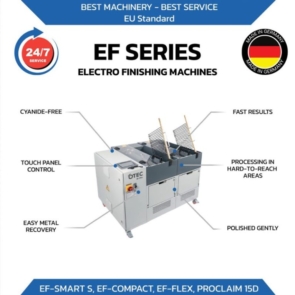
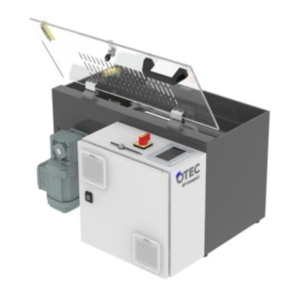
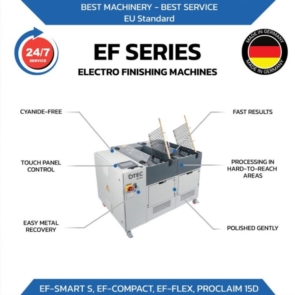
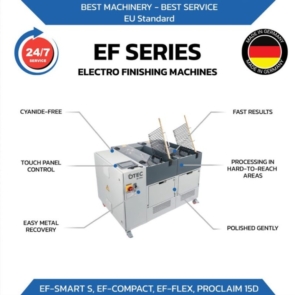
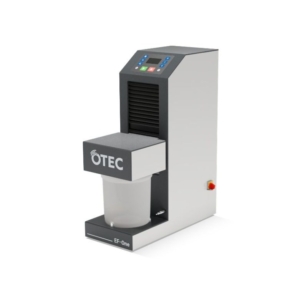
OTEC’s EF series machines available in models from compact desktop units suited to small workshops all the way to production-scale systems replace up to 90% of manual pre-polishing and filing work. A full cycle takes between 10 and 30 minutes, processing multiple pieces simultaneously. The EF-One, for example, handles up to 6 rings per cycle. The EF-Flex processes up to 40 workpieces per container.
Critically, the process is safe for gemstone settings. Diamonds, zirconia and other stones are not damaged. The geometry of the piece is preserved exactly only the surface roughness is removed.
The electrolyte used in modern EF machines is cyanide-free and requires no aggressive acids and the working environment is significantly safer than traditional chemical finishing methods. Recovered gold particles are captured in the liquid through filtration and separated at the cathodes meaning your precious metal loss drops substantially compared to wheel polishing.
Who It Is For
Electro Finishing is not only for large factories. The OTEC EF-One was specifically designed as a plug-and-play entry point for small and medium workshops, with eight pre-installed programs that require no specialist knowledge to operate.
For workshops producing consistent batches whether rings, pendants, bracelets or clasps the economics are straightforward. Less labor time per piece, more consistent output, lower metal loss and a great finish quality on complex geometries.
The Takeaway
The polishing bench is not going away entirely. Skilled finishing work will always have a place for bespoke and repair pieces. But for production batches, Electro Finishing removes the bottleneck, reduces cost and delivers a more consistent result than hand polishing can. The technology has been proven precious metal across gold, silver, stainless steel, titanium and brass and it is now accessible to workshops of every size.
ProTech Transfer Co., Ltd. is the authorised distributor of OTEC finishing machines in Thailand, providing equipment, consumables, and technical support. www.protech-transfer.com
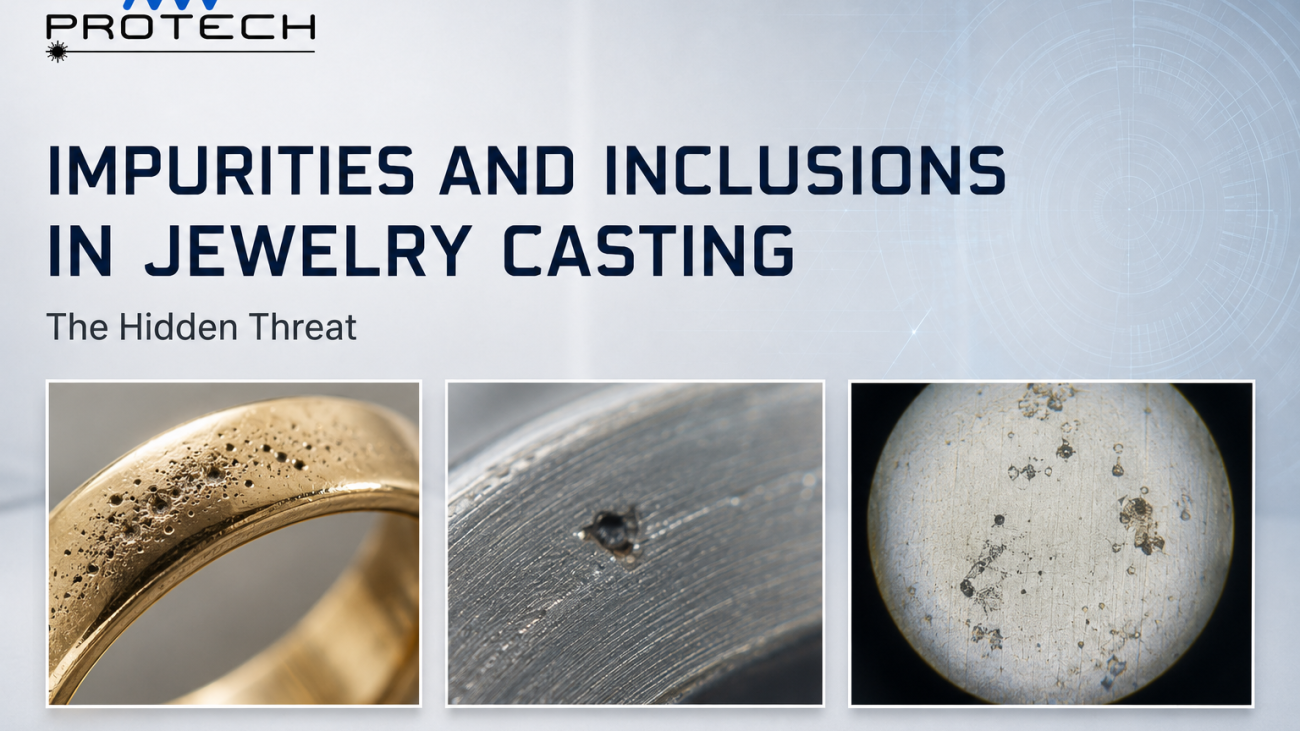
Even trace levels of contamination can compromise the structural integrity and surface finish of cast jewelry. Understanding where these impurities originate and how to stop them is fundamental to defect-free production.
The scale of the problem
In jewelry casting, purity is not a luxury, it is a prerequisite. Metals marketed as 99.9% pure still carry up to 0.1% in residual impurities and that margin is enough to cause serious defects. Iron contamination at concentrations as low as 100–200 ppm has been shown to initiate cracking in gold alloys. Lead and sulphide inclusions can strip an alloy of nearly all its mechanical strength.
Iron contamination at just 100 ppm can initiate cracking in gold alloys.
Where contamination enters the process
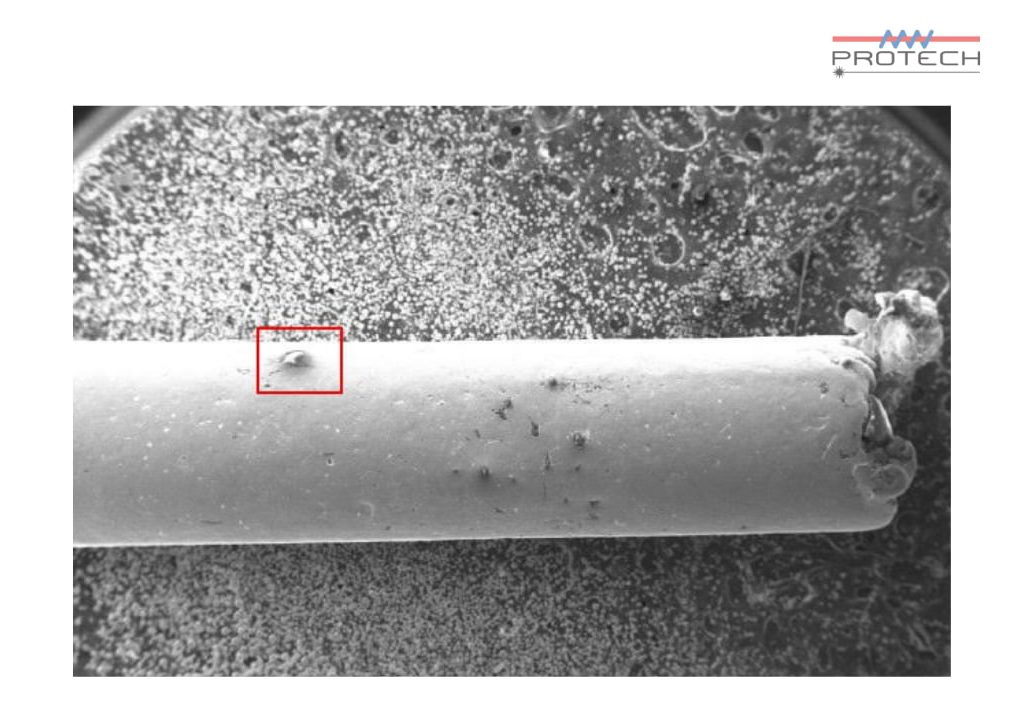
Contamination has three primary entry points. The first is the raw material itself, where even certified metals carry trace elements from refining. The second and most frequently cited is scrap recycling. Inadequately cleaned returns introduce oxides, investment residues and foreign metallic particles directly into the melt. The third is the casting environment: steel tools, worn crucibles and airborne dust all contribute contamination during melting and pouring.
A taxonomy of defects
The type of defect produced depends largely on what entered the melt and when
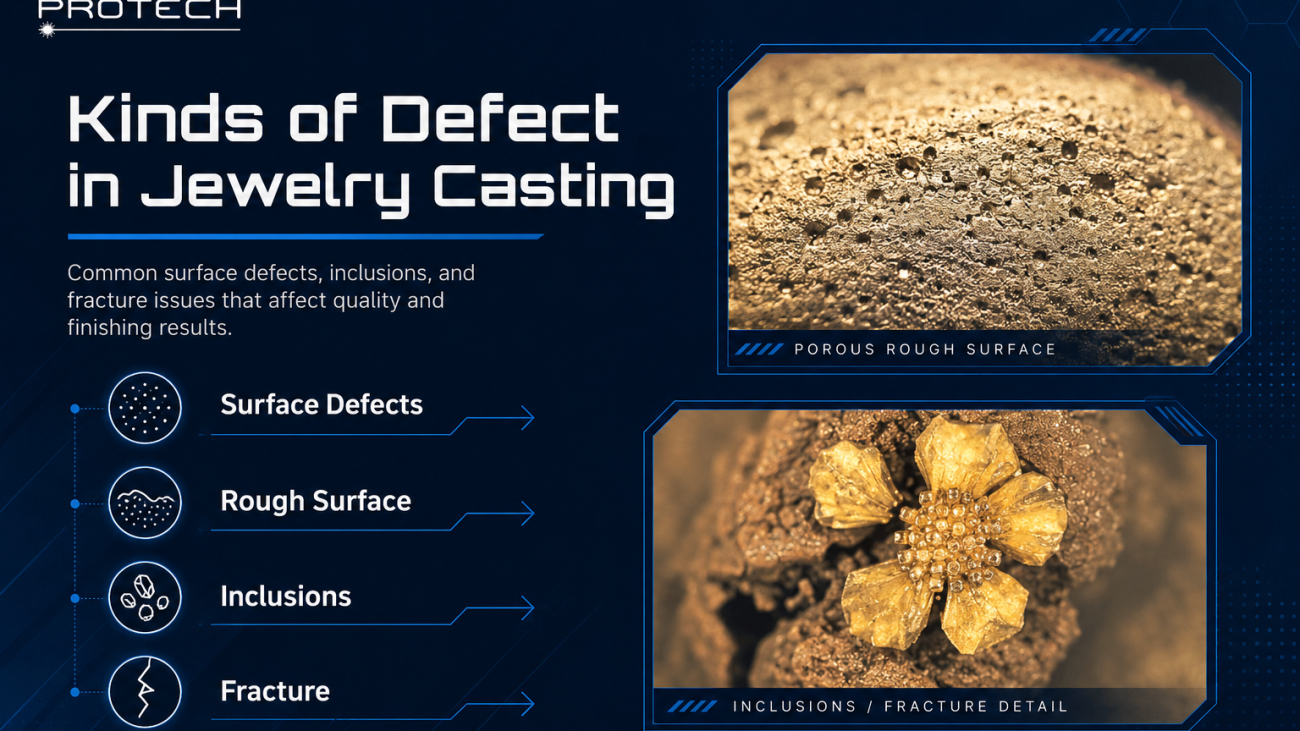
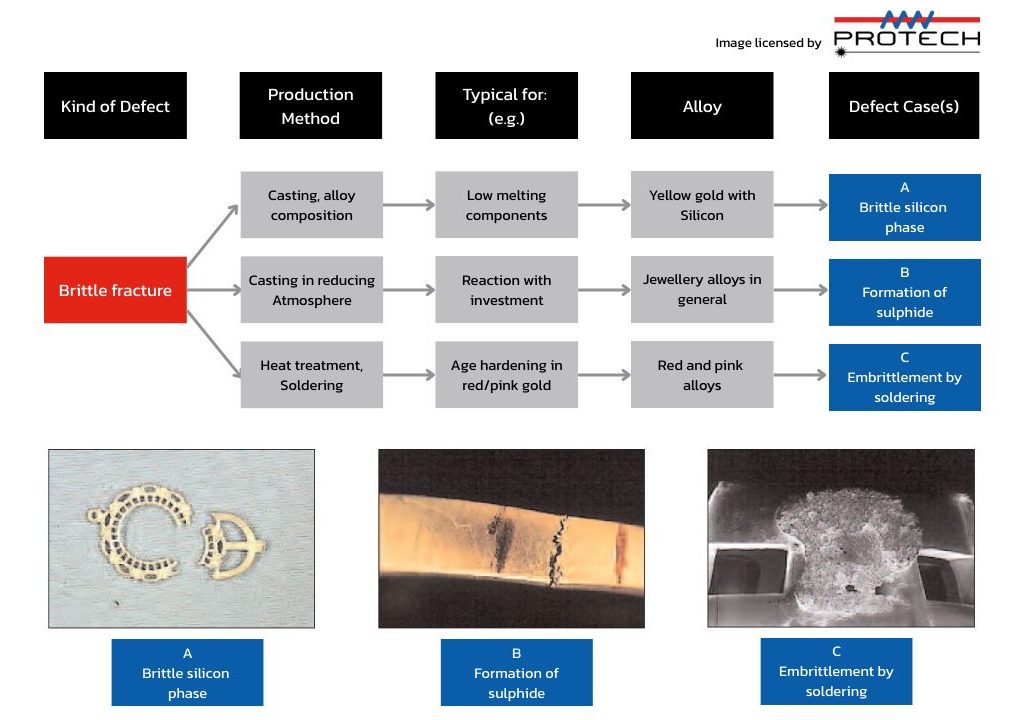
Cracks & brittleness
Iron, lead or sulphide inclusions reducing alloy ductility and strength
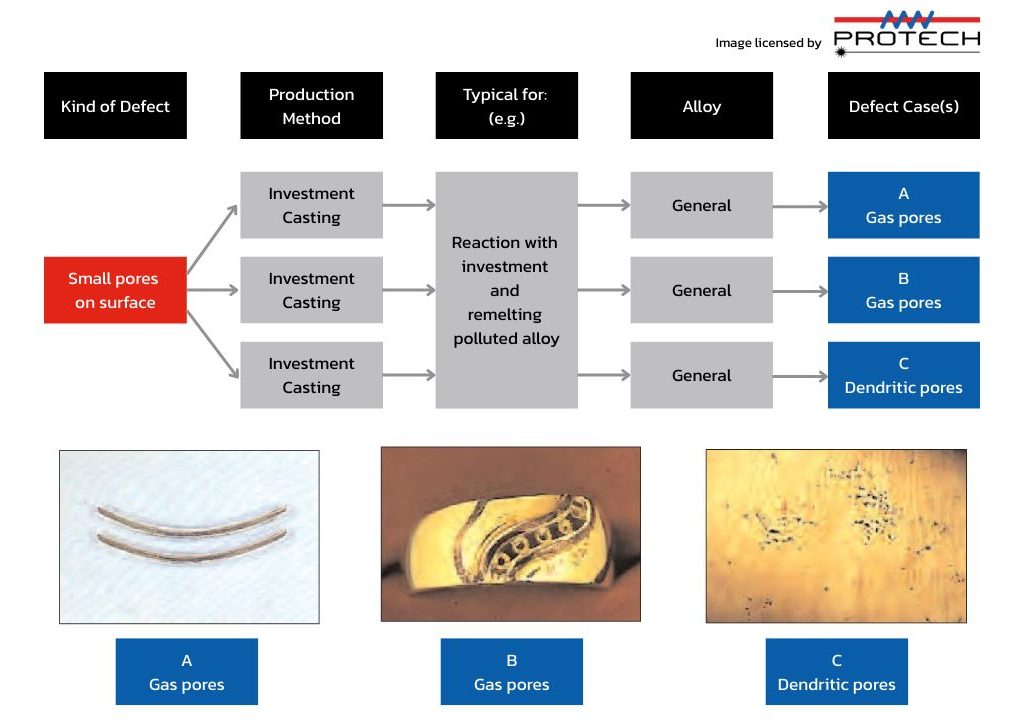
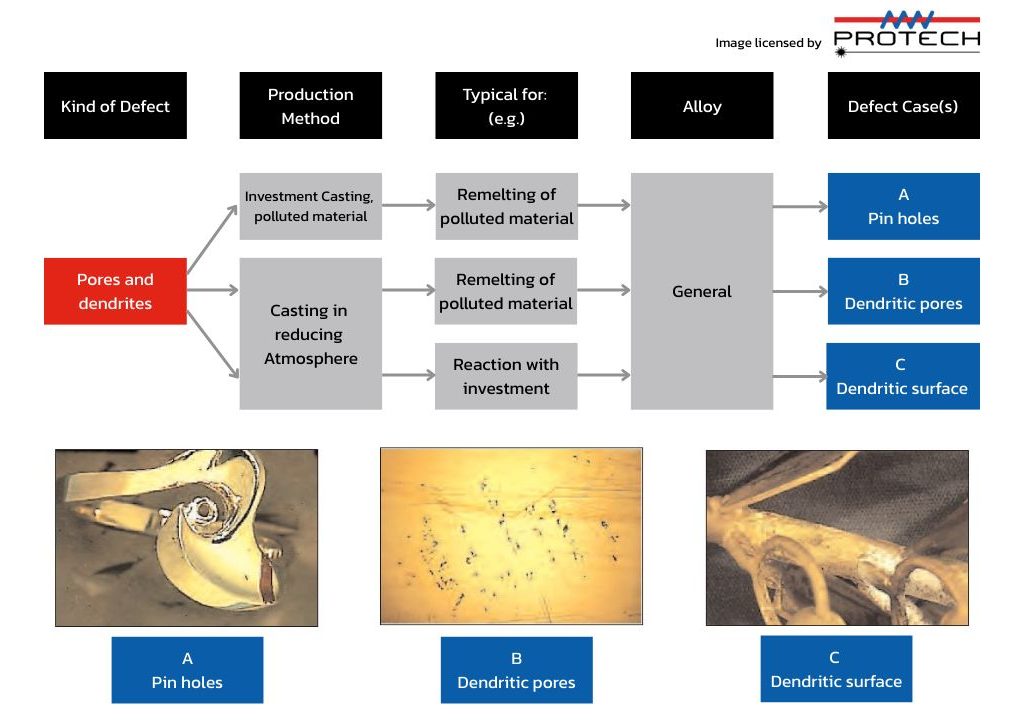
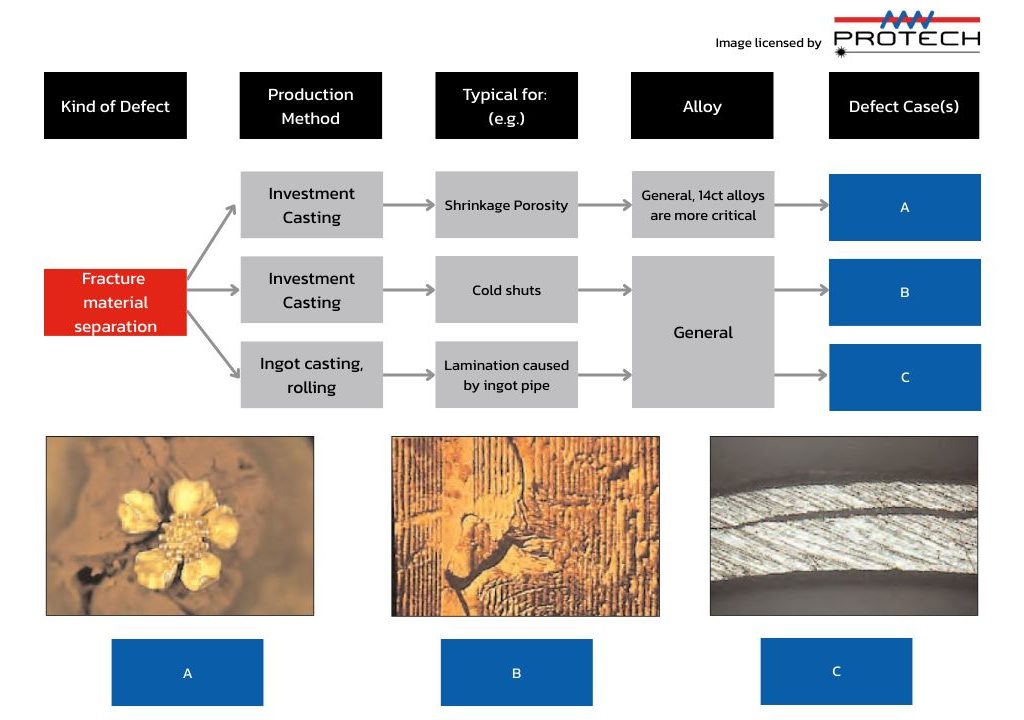
Surface porosity
Investment particles or slag entering the melt; visible after polishing as scattered pores
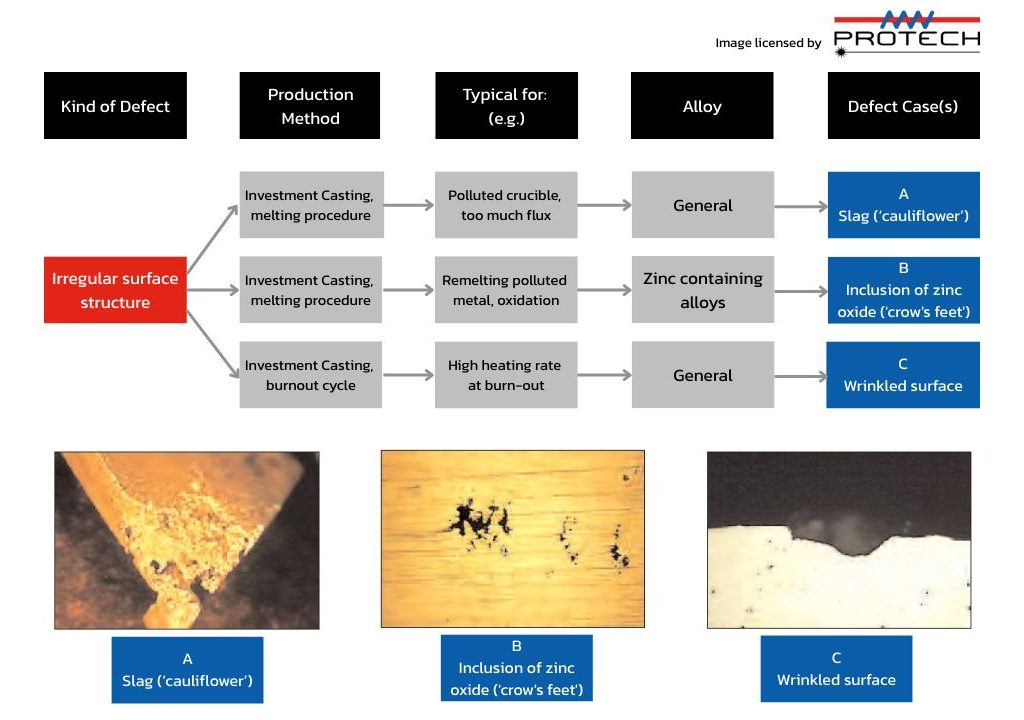
Oxide inclusions
Zinc oxide producing “crow’s foot” porosity is difficult to remove once formed
Slag inclusions
Excess or contaminated flux creating rough, cauliflower-textured surfaces
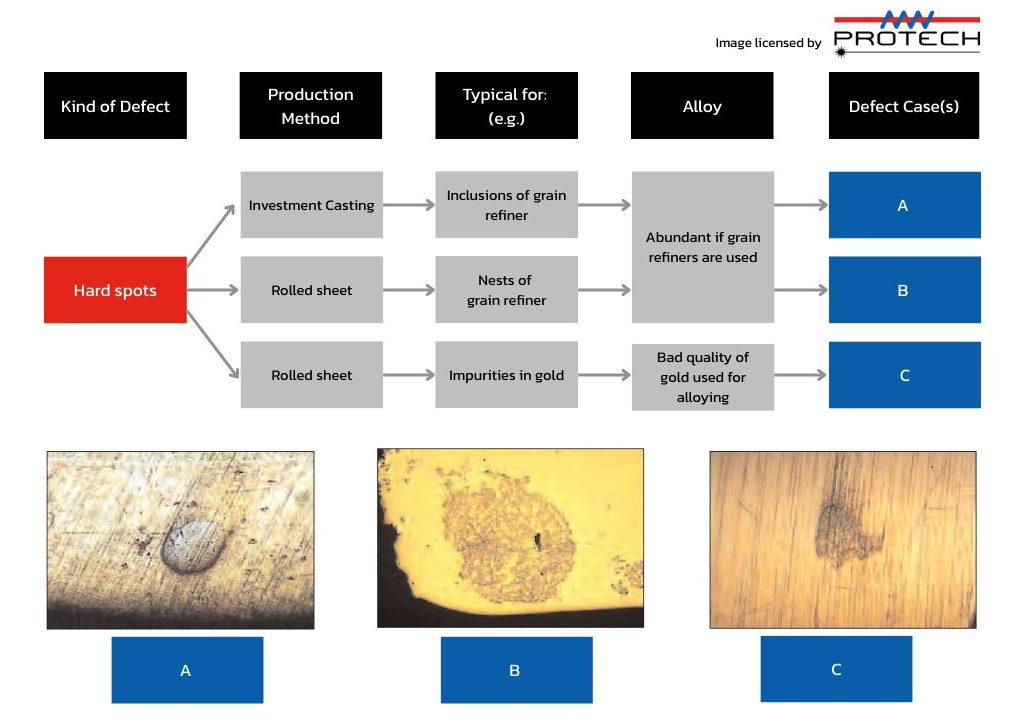
Hard spots
Undissolved grain refiners such as iridium forming particles that resist polishing and cause cracking
Prevention
Control must be applied at every stage of the process, not treated as a final quality check.
Source high-quality, certified raw materials and verify composition
Keep scrap clean; limit the proportion of recycled content per melt
Use dedicated, clean crucibles and replace them before wear introduces contamination
Minimise flux additions and eliminate contaminated stock
Maintain proper investment mixing, storage and burnout procedures
Melt under a protective atmosphere where possible to suppress oxide formation
Conclusion
Impurity control is not a peripheral concern, it sits at the core of casting quality. The consequences of contamination are disproportionate to the quantities involved: a part-per-million problem can become a visible, structural or commercial failure. A disciplined approach to materials selection, scrap management and process hygiene remains the most reliable path to consistent, defect-free output.
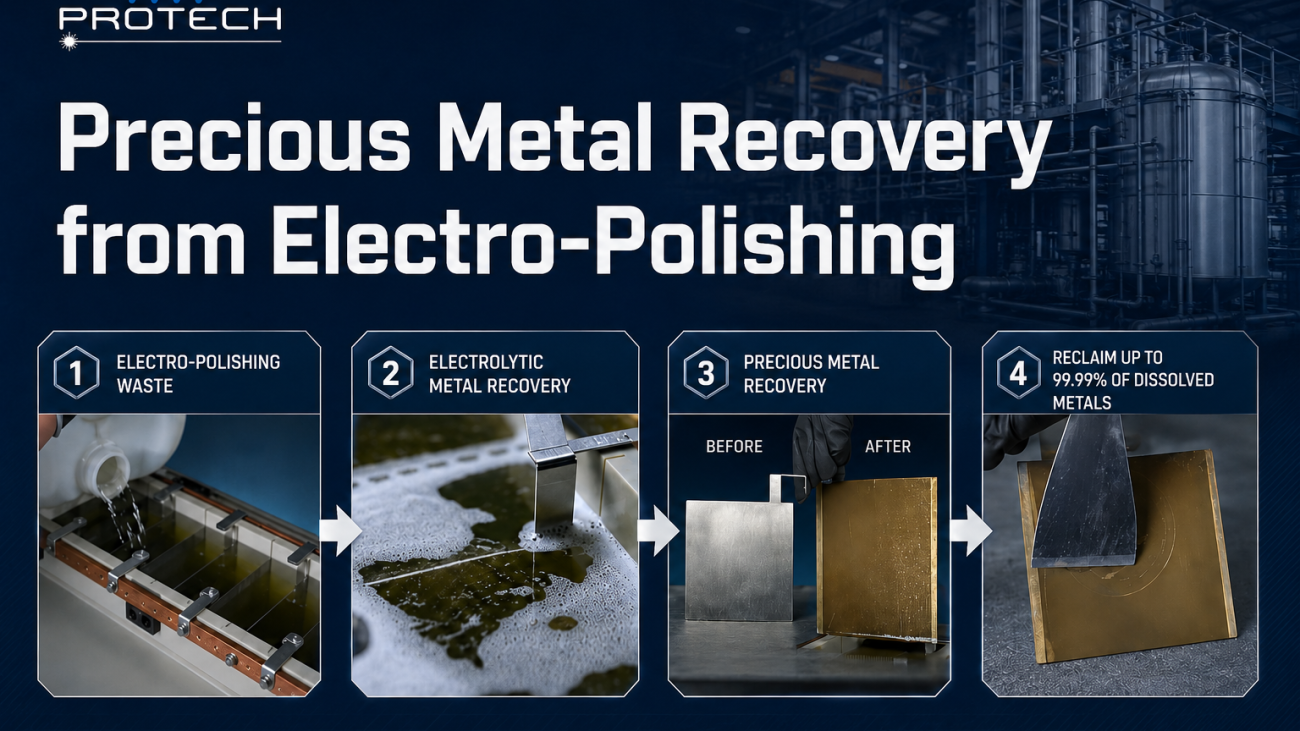
Discover how jewelry manufacturers can recover gold, silver and rhodium from electro-polishing and plating waste using electrolytic metal recovery systems.
Recovering Precious Metals from Electro Polishing Waste: Turning Loss into Value
In jewelry manufacturing, precious metal counts. During electro polishing or plating, the waste liquids can hold significant amounts of valuable metals such as gold, silver, rhodium, etc. Often unknowingly discarded as waste.
Recovering Precious Metal in Liquids
When electro polishing solutions become saturated with dissolved metals or plating baths reach end of life time, they must be replaced. Common practice is to send these liquids to third-party waste treatment and refining. From Waste to Asset: The Electrolytic Metal Recovery Process.
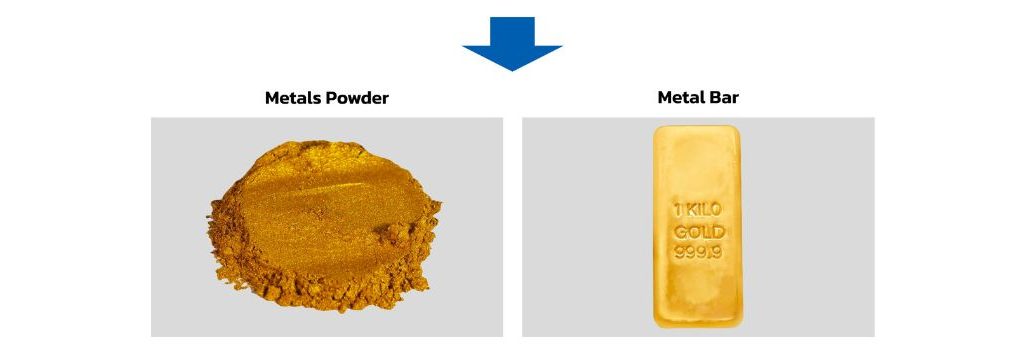
Electrolytic metal recovery systems provide a sustainable and cost-effective way to reclaim precious metals from plating and electro polishing baths. The process uses a controlled electrical current to attract and deposit dissolved metals onto a cathode, forming a metal layer that can be easily scraped off, turning it into metal powder. This recovered metal powder can be melted into metal blocks.
This technology not only minimizes environmental impact but also generates direct financial return transforming waste into a valuable resource.
Real Example: Rhodium Recovery from Polishing Solution
In one test using an electrolytic recovery system, a 5-liter sample of depleted Rhodium plating solution was processed for 36 hours in constant Voltage (CV) mode. The system successfully recovered 1.5 grams of Rhodium, valued at approximately 12,000 THB, with only 96 THB in electrical operating cost. This example clearly demonstrates how much hidden value remains in spent process solutions especially when dealing with high-value metals like Rhodium. This provides a very high Return of Investment (ROI) value.
Why Jewelry Manufacturers Should Consider Metal Recovery?
Implementing a precious metal recovery system in the electro polishing or plating process allows jewelry manufacturers to:
Recover Gold, Silver, Rhodium and other metals directly
Reduce waste disposal costs and hazardous waste volume
Meet environmental compliance standards with lower discharge limits
Improve sustainability through circular production practices
Gain measurable ROI from materials already in use
This approach supports both profitability and environmental responsibility in sustainable jewelry manufacturing.
Solution Spotlight: ProClaim Precious Metal Recovery System
For jewelry manufacturers seeking an efficient, closed-loop solution, the ProClaim Precious Metal Recovery System offers advanced electrolytic metal recovery designed to reclaim up to 99.99% of dissolved metals from electro-polishing and plating solutions. Its closed chamber ensures operator safety with high-purity recovery with minimal maintenance.
By integrating ProClaim into your production line, you can turn waste liabilities into valuable assets achieving cleaner processes and direct cost savings.
Interested to learn more about metal recovery for your polishing process? Contact Protech Transfer to discover how the ProClaim System can be integrated into your workflow.
A universal wave form where the set energy is delivered for the set time, ideal for all types of metals.
Slope Up
Using this waveform the first 20% of the set time provides a gradual increase in the energy until it reaches the set value, ideal for highly reflective metals.
Slope Down
Using this waveform the last 20% of the set time provides a gradual decrease to 0, ideal for opaque or poorly reflecting metals.
Trapezoid
This waveform is a combination of the previous two, ideal for silver-rich metals.
Pulsed
Using this waveform the energy is generated as a chain of pulses for greater piercing effect, ideal for all metals.